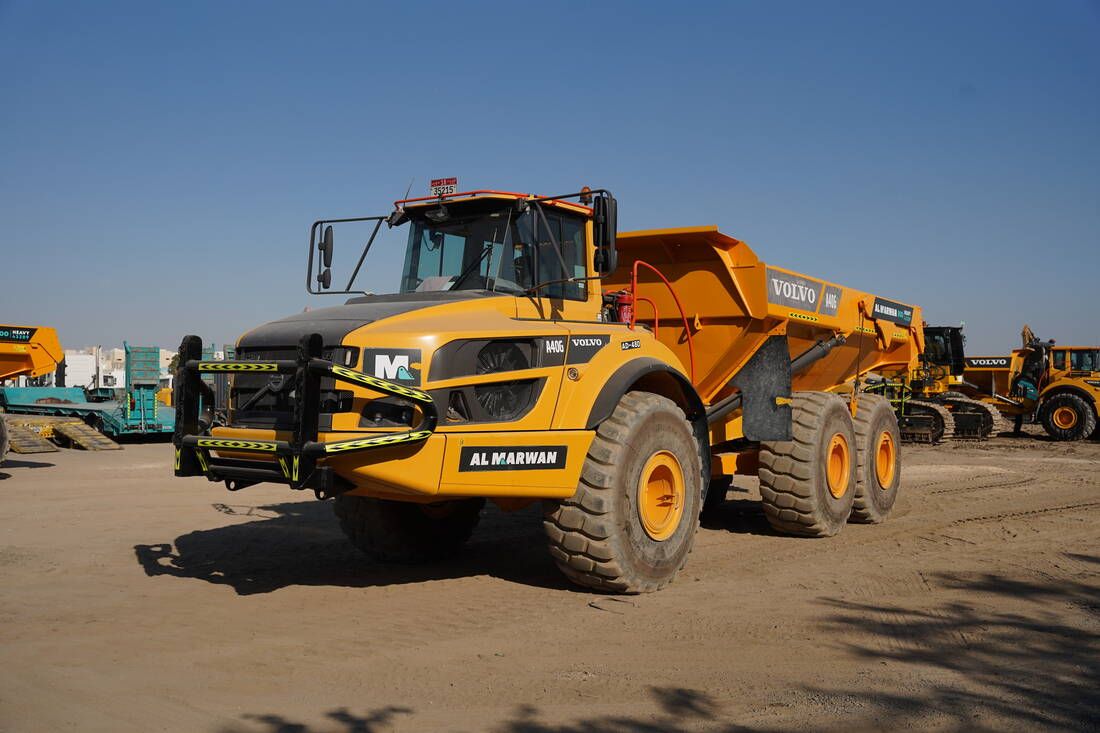
A dump truck looks like the simplest machine on a site — load it, drive it, tip it, repeat. The accident record says otherwise. Almost every serious dump truck incident happens during one of two moments: reversing at the tip point, or with the body raised. Both are avoidable, and both come down to procedure rather than skill. This guide covers dump truck types, controls and braking systems, loading, hauling, the dumping sequence, and the mistakes that most reliably put a truck on its side.
Types of Dump Truck and How They Differ
The term covers several distinct machines with different handling characteristics, and knowing which one you are in matters.
- Rigid (standard) dump trucks are road-legal tipper trucks on a fixed chassis, typically 6x4 or 8x4, used for hauling aggregate, spoil, and asphalt between sites and public roads. They steer with the front axle and depend entirely on road-quality surfaces.
- Articulated dump trucks (ADTs) pivot at a joint between the tractor and the load-carrying rear section, with all wheels usually driven. Articulated dump trucks are designed to carry loads across rough and often muddy terrain that would defeat a rigid truck, and the articulation makes them handle very differently from straight-frame haulers.[1] They dominate off-road earthmoving.
- Rigid off-highway haul trucks are the very large quarry and mine machines — non-road-legal, high payload, and dependent on engineered haul roads.
- Transfer and tractor-trailer dump combinations carry a trailer body and are the configuration most prone to tip-over during dumping, because the raised trailer’s stability depends on a small rear contact patch. On a frameless trailer, raising the body lifts the forward tandem wheels off the ground so the only ground contact is at the rearmost wheels — which is precisely why an uneven surface or a shifting load can put the trailer over.[2]
The operating principles below apply across all of them, with the differences noted where they matter.
Dump Truck Licensing and Operator Requirements
Road-legal rigid dump trucks require a commercial heavy vehicle licence in the appropriate category, plus any additional endorsements for the axle configuration and gross weight involved. Off-highway articulated and rigid haulers are plant machines rather than road vehicles and require plant operator certification specific to that machine class.
Site-specific requirements sit on top of licensing: haul road induction, site traffic management briefing, and, on mine and quarry sites, statutory safety instruction. Mining regulations require operators to establish and maintain a program of instruction covering the safety regulations and procedures at the site, and dump truck operation falls squarely within that requirement.[3]
A licence proves you can drive the vehicle. It does not prove you know that site’s haul road, tip point, or traffic pattern — which is why induction is not a formality.
Dump Truck Pre-Start Inspection Checklist
Walk around before every shift. A full inspection before the start of the shift, and a walk-around any time before getting back into the cab, are both baseline requirements.[4]
- Tyres and wheels. Tyre condition should be checked before operating.[1] Look at pressure, sidewall damage, cuts, and tread. On a loaded truck, a tyre failure at speed on a haul road is a rollover event, not an inconvenience. Check wheel nuts for movement and confirm nut indicators are aligned.
- Brakes and air system. Drain air tanks of moisture. Build system pressure and check the low-pressure warning and the automatic protection valve function. Test service brakes, parking brake, and — where fitted — the retarder before leaving the yard, not on the first downgrade.
- Body and hoist. Check the hoist cylinder for leaks and the mounting pins for wear. Inspect the body for cracks around the hinge points and confirm the tailgate latches and releases properly. Check that the body prop or safety bar is present and functional.
- Fluids and drivetrain. Engine oil, coolant, hydraulic reservoir, fuel, and any visible leaks. On articulated machines, inspect the articulation joint and oscillation bearing for play and grease.
- Cab and visibility. Mirrors adjusted, cameras clean and functioning, reversing alarm audible, beacon working, windscreen and wipers clear, seat belt functional, horn working.
- Note the locations of site hazards before you start: boulders, overhead electric lines, fences, and low branches in the loading, hauling, and dumping areas.[3]
Dump Truck Controls and Braking Systems Explained
The braking system is the part of a dump truck that most rewards understanding, because the failure mode — brake fade on a loaded descent — is both common and unsurvivable.
Most heavy dump trucks carry three separate retarding systems:
- Service brakes — air-actuated drum or, increasingly, oil-cooled wet disc brakes. These are for stopping, not for controlling speed on a grade.
- Engine brake or exhaust brake — uses engine compression to absorb energy without generating brake heat. It is not a substitute for the service brake: it cannot bring the machine to a stop and cannot hold it stationary.
- Transmission retarder — absorbs energy hydraulically through the driveline and provides most of the sustained retarding capacity on modern haulers. Manufacturers typically stage the systems so the engine brake engages first, then the retarder, with the service brakes applied last.
Effective dump truck braking depends on combining air brakes, engine braking, and retarders to manage heat; operators should monitor brake temperature and avoid prolonged continuous braking wherever possible.[5]
The operating principle is the same across manufacturers: apply retarding before you need it, not after. Apply the retarder before cresting a bank, before entering a turn, and before starting down a steep grade. The gear and speed for a descent should be established before the cycle begins, so the retarder can control the truck without ever calling on the service brakes.[6] If the retarder is engaged and engine speed climbs toward overspeed, use the service brake to bring the truck down into a lower gear.
Modern machines add automated layers — hill start assist, site-configurable speed limiters, overload speed restriction, downhill speed control that holds a set speed without the retarder pedal, and rollover prevention systems that monitor speed and frame angle. Useful, but they are backstops. They do not replace choosing the right gear at the top of the hill.
Loading a Dump Truck Correctly
Position where the loader operator has asked you to, and then stay put. Remain in the cab while the machine is being loaded.[7] Getting out during loading puts you in the loader’s blind spot at the exact moment the loader operator is watching the bucket.
Load distribution matters as much as load weight. Material should be placed evenly along the body and centred laterally — a load biased to one side raises the tipping risk during both hauling and dumping. Material heaped high at the front of the body shifts weight forward and unloads the rear axle; material stacked toward the tailgate does the opposite and can overload the rear axle even when total payload is legal.
Do not exceed rated payload. Do not load the machine beyond its capacity.[7] Underloading hurts cost-per-tonne, but consistently exceeding payload limits puts structural fatigue into the chassis, suspension, and tyres — and overloaded trucks destroy haul roads faster, which slows the entire fleet.[8] Overloading also lengthens stopping distance and stresses braking components, while balanced load distribution improves braking stability and reduces skid risk.[5]
On-board weighing systems, where fitted, remove the guesswork. Where they are not fitted, count buckets against a known bucket capacity rather than judging by eye.
For sticky material — wet clay, cohesive spoil — carry-back is a real problem. Material left in the body after each dump accumulates, reduces effective payload, and, more dangerously, can hang up in the raised body and release suddenly.
How to Drive a Dump Truck Safely on Haul Roads
Loaded, a dump truck is a high centre of gravity vehicle with a long stopping distance and limited steering response. Drive it accordingly.
Obey posted haul road speed limits and traffic direction signs, maintain as much clearance as possible from other machines and structures, and stay well away from the edges of cliffs, overhangs, and slide areas.[7]
- Grades. Select the gear that gives full control before starting up a grade rather than shifting partway.[7] On descent, set gear and retarder at the crest. Downshifting a loaded truck mid-descent is difficult and sometimes impossible, and a missed shift on a loaded downgrade leaves you with only the service brakes.
- Slopes and side-slip. A dump truck can tip when working on hills, banks, and slopes, and when crossing ditches, ridges, or other obstacles. If the machine begins to side-slip down a grade, steer downhill.[7] Instinct says steer uphill; that is what puts trucks over.
- Cornering. Reduce speed before the turn, not in it. On an articulated machine, remember the rear section tracks inside the tractor’s line — the tail sweeps differently from a rigid truck and can catch a berm or a parked machine.
- Body down while travelling. Always travel with the dump body lowered onto the frame.[7] This is non-negotiable and is covered again below.
- Reversing. Be aware of blind spots when reversing, adjust mirrors to maximise field of view, always use a spotter or signalperson when backing, and know where other workers are located in the loading, hauling, and dumping areas.[3] Keep the truck — and, on a combination, the trailer — in a straight line when backing, and never reverse faster than walking pace.[9]
The Dumping Sequence: Step by Step
This is the highest-risk operation a dump truck performs, and it has a fixed procedure.
- Assess the tip point before committing. Dump only on level surfaces free of spillage, and ensure elevated dump sites are substantial and fitted with adequate dump point restraints such as berms or wheel stops.[9] Uneven or sloping ground and poorly compacted fill are the surfaces where tip-overs happen.[3] If the tip point has been chewed up by previous trucks, it needs a dozer before it needs another load.
- Reverse in straight and square, with a spotter. Approach so the truck is perpendicular to the edge, not angled across it. Stop short of the berm and let the spotter position you.
- Check for overhead obstructions. A raised body reaches roughly twice the truck’s travelling height. Power lines, conveyor structures, building overhangs, and tree limbs all become live hazards the moment the body goes up.
- Set the parking brake and stay in the cab. Remain in the cab with your seat belt fastened throughout the dumping process.[9] The cab is the protected structure; standing beside the truck is the worst place to be if the body starts to go over.
- Raise the body smoothly and watch it. Watch the mirrors and any body-angle indicator. If the truck starts to lean, lower the body immediately — do not attempt to complete the dump.
- Watch for material hanging up. A slight slope is enough to cause a tip-over if material sticks in the top of the body, and stability is compromised when a large amount of material remains in the upper part of a raised body, when rear wheels settle unevenly as the load moves rearward, or where rear suspension is weak on one side.[3] If the load will not release, lower the body and reposition rather than shaking the truck to free it.
- Do not dump in high wind. Avoid dumping in high or gusty wind conditions.[9] A raised body is a large flat sail on a vehicle with a raised centre of gravity.
- Pull forward and lower the body before driving off. After the load is dumped, pull forward just enough to clear the pile, then put the body down before driving away — leaving the body up while driving risks contact with electrical lines and tip-over.[4]
- Confirm the body is fully seated. Check the indicator or the mirrors before returning to the haul road.
- The frequency of these incidents is not theoretical. Between 2018 and 2024, US mine operators reported 14 injury accidents in which over-the-road trucks tipped or rolled while dumping, alongside 28 injury incidents involving off-road haul trucks tipping or rolling.[9]
Parking and Shutdown Procedure
Park on a level surface where possible; if you must park on a grade, chock the wheels. Apply the service brakes to stop, move the transmission control to park to engage the parking brake, then release the service brakes and confirm the machine holds.[7]
Do not shut the engine down immediately after hauling a heavy load — stopping straight from working load causes overheating and accelerated component wear. Let the engine run for about five minutes so hot areas cool gradually, and do not shut down while a regeneration cycle is active.[7]
Lower the body fully onto the frame, chock as required, and secure the cab.
Working Under a Raised Body
Never do it without the mechanical prop engaged. Engage the body lock bars before performing maintenance or any other work under a raised body.[3] Hydraulic hoists hold by pressure, and pressure can be lost through a hose failure, a seal failure, or an inadvertent control movement. The prop is a mechanical stop that does not depend on anything staying intact.
Common Dump Truck Operating Mistakes
- Driving with the body raised. The single most avoidable cause of power line contact and tip-over. Confirm the body is down every time before moving.
- Dumping on unassessed ground. Fresh fill settles under load. A tip point that was fine two hours ago may not be now.
- Exiting the cab during dumping. The cab protects you. Leaving it during the operation puts you in the crush zone.
- Reversing without a spotter. Rear blind spots on a loaded dump truck are large enough to conceal a person entirely.
- Riding the service brakes downhill. Heat builds, brakes fade, and by the time you notice, you have no options left. Set retarding at the top.
- Overloading. Damages the truck, damages the haul road, and lengthens stopping distance at exactly the moment you need it shortest.
- Complacency. It is very easy to become complacent operating this equipment — maintain focus during operation, and stop work if you do not feel trained or comfortable with the task at hand.[4]
Best Practices for Efficient Dump Truck Operation
Know the site before the first load. Learn the job site boundaries — speed limits, grades, and traffic patterns — before operating.[1] Drive the haul road empty first if you can, and note where the tight corners, soft edges, and blind crests are.
Keep the cycle smooth rather than fast. Time is lost at the loading face and the tip point, not on the haul, and aggressive driving between them costs fuel, tyres, and haul road condition for a marginal gain.
Let modern transmissions choose shift points in standard conditions rather than fighting them; automated gear selection reduces mechanical stress on the engine and driveline and lets the operator concentrate on the road.[8]
Report haul road defects rather than driving around them. Potholes, ruts, and soft spots that get avoided rather than reported become worse and eventually become someone’s rollover.
Maintain consistent payloads. Judging load by eye is difficult, which is why consistency across a fleet is easier to achieve with on-board weighing than with estimation.[8]
Frequently Asked Questions About Operating a Dump Truck
- What is the most dangerous part of dump truck operation? Dumping. Tip-overs during dumping are driven by sloping or uneven ground, poorly compacted fill, material sticking in the raised body, and uneven rear wheel settlement as the load shifts rearward.[3] Reversing at the tip point runs a close second.
- Should I stay in the cab while dumping? Yes. Stay in the cab with your seat belt on throughout the dumping process.[9] The same applies during loading.
- Can I drive with the dump body raised? No. Lower the body before driving off; travelling with it raised risks power line contact and tip-over.[4]
- What is the difference between a retarder and the service brakes? The retarder controls speed continuously without generating brake heat; the service brakes stop the vehicle. Engine and retarder braking are not substitutes for the service brake — neither can bring the machine to a stop or hold it stationary.
- How is an articulated dump truck different to drive? The articulation makes it behave differently from a straight-frame hauler, and ADTs are built to work on rough, muddy ground where stability is already compromised.[1] It steers by bending at the joint, so the rear section tracks a different line through corners, and all-wheel drive changes how it behaves on loose surfaces.
- What should I do if the truck starts sliding sideways on a grade? Turn the machine downhill.[7] Steering uphill increases the sideways loading that causes rollover.
References
- “How to Safely Operate an Articulated Dump Truck.” Construction Equipment. https://www.constructionequipment.com/earthmoving/article/55039692/how-to-safely-operate-an-articulated-dump-truck
- United States Patent 4,988,974, “Warning and safety system indicating truck trailer tip-over condition.” USPTO. https://image-ppubs.uspto.gov/dirsearch-public/print/downloadPdf/4988974
- “Dump Truck Safety Tips.” HSSE World. https://hsseworld.com/dump-truck-safety-tips/
- “Safety — Dump Truck Operations.” JRVR Group Loss Control Resource Library. https://jrvrgroup.com/falls-lake-insurance/loss-control/loss-control-resource-library/safety-dump-truck-operations
- “Dump Truck Brake Systems Explained: Performance Guide.” Ruida Truck, 2026. https://ruidatruck.com/dump-truck-brake-systems-explained-performance-guide/
- “Trucks: Drive Like a Pro.” Equipment World. https://www.equipmentworld.com/workforce/safety/article/14945244/trucks-drive-like-a-pro
- “Work Hard with Articulated Truck Operating Tips.” Caterpillar. https://www.cat.com/en_US/articles/for-owners/work-hard-with-articulated-truck-operating-tips.html
- “5 Ways Haul Truck Operators Can Extend Component Life.” Volvo Construction Equipment, 2026. https://www.volvoce.com/united-states/en-us/resources/blog/2026/5-ways-haul-truck-operators-can-extend-component-life/
- Mine Safety and Health Administration. Truck Dumping — Safety Alert. https://www.msha.gov/truck-dumping-safety-alert