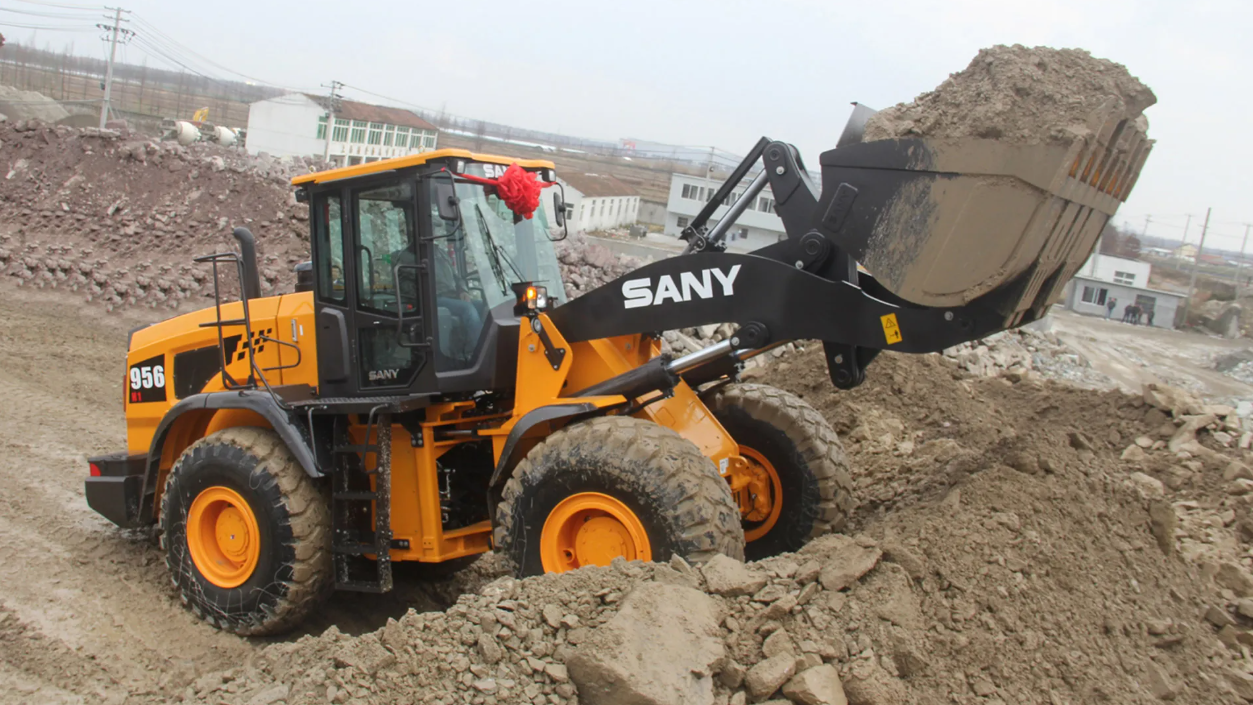
A wheel loader is a production machine, and production machines are judged on cycle time. The controls take an afternoon to learn. What separates a competent operator from an expensive one is whether the bucket comes out full every pass, whether the travel path is as short as it can be, and whether the machine is being turned under load in ways that quietly destroy tyres and articulation joints. This guide covers wheel loader components, controls, the loading cycle, truck loading patterns, stability, and the habits that determine cost per tonne.
What Is a Wheel Loader and How Does It Work
A wheel loader is a four-wheel-drive machine with a front-mounted boom and bucket, built to scoop, carry, and load loose material. Almost all full-size wheel loaders use articulated steering: the machine pivots at a centre hinge between the front and rear frames, so the front wheels and rear wheels track the same path through a turn.
Articulated steering turns with far less ground disturbance than skid steering, which reduces tyre wear and surface damage, and it allows a longer wheelbase than a comparable skid steer, giving greater stability and a smoother ride.[1] The rear frame typically pivots up to around 40 degrees each way from straight.[2]
Most machines also carry an oscillating rear axle. This lets the rear axle tilt independently so that when one wheel rides over an obstacle, the remaining wheels stay planted — maintaining four-point contact and traction on uneven ground.[3] It also has stability consequences during turns, covered below.
- Drivetrain configurations vary. Wheel loaders use torque converter transmissions, hydrostatic continuously variable transmissions (HST), or hydraulic-mechanical continuously variable transmissions (HMT), and machines shift between ratios frequently to match travel speed and drive force to the task.[4] Torque converter machines dominate the larger classes; hydrostatic drive is common on compact loaders and offers finer control at low speed.
- Loader linkage comes in two main forms. Z-bar linkage gives high breakout force and is the standard for aggressive digging in bank material. Parallel-lift (or tool carrier) linkage keeps the attachment level through the lift range, which matters for forks and pallet handling.
Wheel Loader Controls and Cab Layout
The control set is straightforward, but the auxiliary functions are where efficiency lives.
- Steering is via wheel or joystick. Articulated machines respond differently from a rigid vehicle: the rear frame swings out as you turn, so the machine’s tail sweeps across ground you may not be watching. Joystick steering reduces operator fatigue on high-cycle work but takes adjustment.
- Boom and bucket are controlled by a single lever or twin levers — raise and lower on one axis, tilt back and dump on the other. Most machines allow simultaneous lift and tilt, which is essential for a full bucket.
- Transmission and direction. A forward-neutral-reverse control, usually on the steering column or integrated into the loader lever. Manual gear selection matters more than operators assume; automatic modes will not always pick the right gear at the pile.
- Kickdown. A button that forces a downshift to the lowest gear for maximum tractive effort. During bucket filling, the operator uses the kickdown function to shift into the lowest gear, then simultaneously controls machine speed via the throttle and the lift and tilt functions via the hydraulic levers to fill the bucket. Lifting the loader unit slightly during this phase increases force on the front axle, which improves traction.[5]
- Declutch (transmission cut-off). Disconnects drive from the wheels when the brake is applied. This lets engine power be diverted fully to the hydraulic system for faster lifting while the machine is stationary at the truck or the pile.[6] Learning to use declutch properly is one of the largest single gains available to a new operator.
- Return-to-dig and auto-levelling. Return-to-dig stops the boom at a predetermined point when lowering, so the bucket starts each cycle in the same position. Auto-levelling brings the bucket from a dump or dig position to the carrying position automatically for travel.[7] Both remove guesswork and eliminate the corrections that cost seconds every cycle.[8]
Wheel Loader Pre-Start Inspection Checklist
Conduct a comprehensive inspection before beginning operations: check hoses, fittings, and cylinders for leaks; confirm correct tyre pressure, which affects both stability and fuel efficiency; look for excessive wear or structural damage; and verify cameras, lights, alarms, and mirrors are functioning.[9]
Working around the machine:
- Tyres. Pressure, cuts, sidewall damage, and tread depth on all four. Uneven pressures on an articulated machine skew handling and accelerate wear. Tyres are among the highest running costs on a wheel loader, so this check pays for itself.
- Articulation joint. Inspect the centre hinge pins, bearings, and steering cylinders for play, leaks, and grease. Confirm the articulation lock bar is present — it is fitted before transport or maintenance to stop the frames folding.
- Loader linkage. Check boom, bucket, tilt linkage, and pins for cracks, wear, and missing retainers. Inspect the bucket cutting edge and teeth; a worn edge dramatically increases the effort needed to fill.
- Hydraulics. Reservoir level with the boom fully lowered and bucket flat. Check cylinders for scoring and rod seepage.
- Fluids and drivetrain. Engine oil, coolant, transmission and axle oil, and fuel. Look for leaks under the machine, particularly around the final drives.
- Cab and safety. Seat belt, ROPS/FOPS structure integrity, mirrors and cameras clean, reversing alarm audible, horn working, steps and handholds clean.
How to Fill a Wheel Loader Bucket Correctly
Bucket filling is the phase that determines everything downstream. A bucket that comes out 70% full means an extra pass per truck, which means roughly a third more cycles for the same tonnage.
- Approach square and low. Approach with the bucket level and low to the ground.[9] The cutting edge should be flat and just touching the surface — not tipped down, which digs into the floor, and not tipped back, which rides over the material.
- Enter with momentum, not speed. Operator technique is critical: set the bucket level entering the pile, then use smooth actuation of the lift and tilt functions to maintain momentum pushing into the pile. Done badly, the machine bucks violently or gets stuck in the pile with the wheels spinning.[10]
- Lift and tilt together as you penetrate. Small lift inputs transfer weight onto the front axle and improve traction; small tilt inputs break material into the bucket. Both applied in a smooth, continuous sequence — not as separate discrete moves.
- Do not spin the wheels. Forcing the bucket into a pile by spinning the wheels is counterproductive and causes rapid tyre degradation — one of the highest operating costs in heavy equipment.[6] Excessive wheel spin also wastes fuel.[9] If the wheels break traction, back out and re-enter at a shallower angle.
- Work the face systematically. Take material from the bottom of the pile where it is loosest, and work across the face in a consistent direction rather than gouging holes at random. A clean, well-maintained face fills buckets faster than a chewed-up one.
- Do not chase overfill. Overloading a bucket does not automatically improve productivity.[6] Material spilling from an overfull bucket has to be cleaned up, and it lands on the loading floor where it degrades traction for every subsequent pass.
The V-Pattern and Y-Cycle: Truck Loading Technique
This is the highest-value section for anyone loading trucks, because loading pattern is where most cycle time is won or lost.
Two factors dominate loading efficiency: where the trucks sit relative to the loading face, and how well the operator fills the bucket each pass. A 3 cubic yard loader working a loose stockpile into 9 cubic yard trucks should complete a full cycle — fill, dump, return to face — in about 30 seconds, loading the truck in three passes. For on-highway trucks, filling in two to three loader passes is optimal.[11]
- The V-pattern (also called the Y-cycle) works like this. Position the truck with its rear just off the edge of the pile. The loader starts at roughly a 45-degree angle to both the pile and the truck, pulls forward curving toward the pile to fill the bucket, reverses back to the 45-degree starting position, then pulls forward curving the other way to dump into the truck, and reverses back to the starting angle to begin again. The path traced is a V or Y shape, which is where the name comes from.[12]
- Keep the pattern tight. Caterpillar recommends around 1.5 wheel revolutions on each side of the V, working across the face in one consistent direction, usually left to right.[13] Aim for a 1.5 to 2-turn cycle; if the loader is travelling more than two machine lengths to reach the truck, the site layout is costing money in fuel and tyre life. A tight V minimises travel distance and reduces articulation angle, and excessive turning under load puts heavy stress on the centre hitch and increases tyre scrubbing.[6]
- Truck positioning must be consistent. If trucks are spotted inconsistently, the Y cycle becomes too big or too small. Too close to both the truck and the pile makes manoeuvring at efficient speed difficult and forces extra steering inputs, which slows the cycle.[12]
- Keep truck drivers on the loader’s side. Working left to right across the face, keep truck drivers on the same side of the truck as the loader so they do not reverse into the loading zone.[13]
- Match bucket to truck. Select a bucket that fills the trucks in minimal cycles without exceeding the machine’s capacity — factor in truck capacity, daily load requirements, and the manual’s capacity and tipping load figures.[8] Material density matters here: bucket selection is as critical as machine selection for achieving pass-match.[11] Loading a truck in 2.5 passes means every second truck gets a half-bucket, which is worse than a clean 3-pass match.
- The productivity gain from proper V-pattern loading is significant — industry figures put it at up to 20%.[9]
Load and Carry Operation
The second common working pattern is load-and-carry: filling the bucket, travelling with the load to a hopper or stockpile, discharging, and returning empty.[4] This is a different discipline from truck loading.
- Carry low. Keep the bucket just high enough to clear obstacles — typically 300–400 mm. Every centimetre higher raises the centre of gravity on a machine already carrying its load ahead of the front axle.
- Tilt back fully. Material spills from a bucket carried flat, and spillage on a haul route becomes a traction hazard for every machine that follows.
- Slow before turning, not during. Articulated machines lose stability in turns, and doing so with a raised load is the classic tip-over sequence.
- Choose gear before the grade. On upgrades, select the gear that holds full control before you start. On downgrades with a load, use the transmission and engine braking rather than riding the service brakes.
Wheel Loader Stability and Rollover Risk
Understanding why an articulated loader tips is worth more than a list of rules.
When a load is lifted at the front of the machine, there must be enough weight at the rear to keep the rear wheels on the ground. In some applications, the load weight approaches the rear counterweight. As the machine begins to travel, a sharp turn shortens the effective distance to the rear weight, and the machine can become unstable — lifting the rear end and causing a travelling tip-over. A stationary tip-over can also occur when picking up a load that puts excessive weight on the front.[14]
That is the mechanism: articulating reduces your stability margin. Turning moves the rear frame laterally relative to the front, shifting the centre of gravity toward the tipping edge at exactly the moment lateral forces are highest.
On steep slopes or in fast turns, the relative rotation between the rear body and rear axle can produce instability from lateral force, while the lateral shift of the centre of gravity during turning further reduces stability and raises rollover probability.[15]
The practical implications:
- The oscillating axle is not a free pass. It improves ground contact over obstacles but reduces stability during turns — the mechanism that keeps four wheels on uneven ground is the same one that allows lateral movement in a corner.
- Speed and turn radius compound. Rollover risk rises with both lateral acceleration and slope angle. A turn that is safe at 5 km/h on the flat is not safe at 15 km/h on a 5% cross-slope.
- Load height is a multiplier. The centre of gravity height directly drives the rollover threshold. A full bucket at travel height is a different machine from a full bucket at dump height.
- ROPS protects you after the fact. Off-highway machines sold in the EU and US are required to carry rollover protective structures meeting international standards[15] — but ROPS only works with the seat belt fastened. Unbelted, a rollover ejects the operator into the structure’s crush path.
Practical rules: travel and turn with the bucket low, reduce speed before every turn, never turn sharply with a raised load, travel straight up and down slopes rather than across, and treat cross-slopes as tip conditions rather than inconveniences.
Site Layout and Safe Operating Practices
Positioning is critical: minimise travel distance between stockpiles and trucks, and avoid crossing paths with other machines wherever possible. Always ensure clear sight lines.[9]
- Maintain the loading floor. A rutted, spilled-on loading area slows every cycle, damages tyres, and reduces traction at exactly the point where traction fills the bucket. Cleaning up spillage is production work, not housekeeping.
- Establish a one-way traffic pattern. Reversing is where visibility is worst and where most struck-by incidents happen. A layout that lets loaders and trucks circulate in one direction removes most of the conflict.
- Never operate with anyone in the swing path of the rear frame. On an articulated machine, the tail sweeps a wide arc that people standing beside the machine consistently underestimate.
- Never lift or carry people in the bucket. The bucket is not a work platform, and no attachment converts it into one.
- Watch for overhead hazards at maximum boom height — power lines, conveyor structures, silo overhangs.
Fuel Efficiency and Cost Per Tonne
Modern wheel loaders with eco-modes can reduce fuel consumption by 10–25%.[9] But operator technique moves the number further than machine settings do.
Fuel burn on a wheel loader is concentrated in three places: wheel spin at the pile, unnecessary travel distance, and high-rpm operation where the declutch would have delivered the hydraulic power instead. Each of these is a technique problem.
Small efficiency losses compound quickly. On a loader filling a bucket, dumping, and returning in 30 seconds, adding just six seconds per pass — a 20% cycle time increase — meaningfully reduces the truckloads moved in a morning.[13]
Track pass-match, cycle time, and bucket fill factor rather than relying on impressions. A loader that averages 85% bucket fill on a three-pass match is outperforming one that averages 100% on a four-pass match, and neither is obvious from the seat.
Parking and Shutdown Procedure
Park on level ground, clear of traffic routes and stockpile edges. Lower the bucket flat to the ground — never leave the boom suspended on hydraulic pressure, since cylinder drift over a long stop is normal.
Apply the parking brake, reduce to idle, and let the engine run briefly before shutting down after heavy work so turbo and coolant temperatures fall gradually. Turn off the master isolator and remove the key.
If the machine must be left on a grade, chock the wheels and turn the bucket into the slope. Fit the articulation lock bar before any transport or maintenance work.
Common Wheel Loader Operating Mistakes
- Spinning the wheels at the pile. Burns fuel, destroys tyres, and does not fill the bucket faster.
- Turning sharply under load. Stresses the centre hitch, scrubs tyres, and is the primary travelling tip-over mechanism.
- Carrying the bucket high. Raises the centre of gravity for no benefit and reduces forward visibility.
- Working an untidy face and floor. Costs seconds on every single cycle for the whole shift.
- Ignoring the declutch. Operators who never learn it work the engine harder and lift slower at the same time.
- Inconsistent truck spotting. Allows the loader’s travel path to grow cycle by cycle without anyone noticing.
- Skipping the seat belt. ROPS does not protect an operator who has been thrown out of the seat.
- Mismatched bucket size. A bucket too big overloads the machine; too small adds a pass to every truck.
Frequently Asked Questions About Operating a Wheel Loader
- What is the V-pattern in wheel loader operation? A loading path where the loader works between the pile and a truck positioned at roughly 45 degrees, tracing a V or Y shape by curving forward into the pile, reversing to the start point, then curving forward to the truck.[12] It reduces steering movements and cycle times, with productivity gains reported up to 20%.[9]
- How many passes should it take to load a truck? Two to three passes is optimal for on-highway trucks, which requires matching bucket size to truck capacity and material density.[11]
- Why should I avoid spinning the wheels when filling the bucket? It causes rapid tyre wear — among the highest operating costs on the machine — and does not improve bucket fill.[6] It also wastes fuel.[9]
- What does the declutch or transmission cut-off do? It disconnects drive to the wheels so engine power goes to the hydraulics, giving faster lifting while the machine is stationary at the pile or truck.[6]
- Why do wheel loaders tip over during turns? Turning shortens the effective distance to the rear counterweight, and with a heavy front load the rear wheels can lift off the ground, producing a travelling tip-over.[14] Lateral centre-of-gravity shift during the turn compounds the effect.[15]
- What is return-to-dig? A function that stops the boom at a preset point during lowering so the bucket begins every cycle in the same position, removing repositioning time from each pass.[7]
- How is a wheel loader different from a skid steer? Articulated steering turns with far less ground disruption and tyre scrubbing than skid steering, and permits a longer wheelbase, giving more stability and a better ride.[1] Wheel loaders are production machines for volume material handling; skid steers are compact machines for confined-site versatility.
References
- United States Patent 12,559,903, “Compact articulated-steering loader.” USPTO. https://image-ppubs.uspto.gov/dirsearch-public/print/downloadPdf/12559903
- United States Patent 10,731,321, “Compact articulated-steering loader.” USPTO. https://image-ppubs.uspto.gov/dirsearch-public/print/downloadPdf/10731321
- “Compact Articulated Wheel Loader: Stability Meets Agility.” Tobeter, 2026. https://www.tobeter.net/compact-articulated-wheel-loader-stability-meets-agility811
- United States Patent 11,885,398, “Power transmission device for vehicle.” USPTO. https://image-ppubs.uspto.gov/dirsearch-public/print/downloadPdf/11885398
- “An Event-driven Operator Model for Dynamic Simulation of Construction Machinery.” arXiv. https://arxiv.org/pdf/cs/0506033
- “7 Expert Wheel Loader Operation Tips for Peak Site Performance.” MineLoaders, 2026. https://mineloaders.com/news/7-expert-wheel-loader-operation-tips-for-peak-site-performance/
- “Wheel Loader Operator Tips: How to Load Trucks with Added Efficiency and Productivity.” Volvo Construction Equipment, 2025. https://www.volvoce.com/united-states/en-us/resources/blog/2020/wheel-loader-operator-tips-how-to-load-trucks-with-added-efficiency-and-productivity/
- “Best Practices for Loading Dump Trucks with Wheel Loaders.” Star Equipment. https://www.starequip.com/blog/best-practices-for-loading-dump-trucks-with-wheel-loaders—68602
- “Wheel Loader Operator Tips: How to Load Trucks Efficiently and Safely.” Rippa Group, 2026. https://www.rippa.com/wheel-loader-operator-tips-how-to-load-trucks-efficiently-and-safely/
- “How to Improve Wheel Loader Productivity.” Ascendum Machinery, 2025. https://ascendummachinery.com/wheel-loader-productivity-tips/
- “Your Manual to Effective Truck Loading.” Construction Business Owner, 2026. https://www.constructionbusinessowner.com/equipment/your-manual-effective-truck-loading
- “Wheel Loader Operator Tips for Dump Trucks.” Luby Equipment, 2024. https://www.lubyequipment.com/wheel-loader-operator-tips-for-dump-trucks/
- “How to Use a Wheel Loader.” Construction Equipment. https://www.constructionequipment.com/earthmoving/wheel-loaders/article/10708513/how-to-use-a-wheel-loader
- United States Patent 6,437,701, “Apparatus and method for a machine stability system for an articulated work machine.” USPTO. https://image-ppubs.uspto.gov/dirsearch-public/print/downloadPdf/6437701
- “Control Methods for Roll Instability of Articulated Steering Vehicles.” Mathematical Problems in Engineering, Wiley, 2016. https://onlinelibrary.wiley.com/doi/10.1155/2016/8041816